The short answer: AI is a brilliant crew with no vision of its own. Ask it for an idea and it gives you a polished version of the most likely idea, which is the same one it gives everyone else. Studies now show the pattern clearly: work made with AI looks better piece by piece, while the work across a whole field gets more alike. So the edge doesn't go to the people who use AI the most. It goes to experts who arrive with a clear vision and direct AI to carry it out. Lead the work. Don't hand it over.
| Keep it yourself | Hand it to AI |
|---|---|
| The idea and the angle | Variations on your idea |
| What good looks like (the brief, the style, the standard) | First drafts against that standard |
| The final call on what ships | Resizing, reformatting, repetitive production |
| Your point of view and your stories | Research, summaries and fact-finding (checked) |
| Saying no | Doing it again, faster |
Does AI really make everyone's work look the same?
Yes, and it hides it well.
Researchers analysed about 373,000 college admission essays written before and after ChatGPT arrived. After ChatGPT, the vocabulary got more varied while the ideas got less varied, both within essays and between them. And here's the catch: readers rated the newer essays as more creative. The surface got fresher while the substance converged.
A brainstorming study found the same thing in a smaller setting. People using ChatGPT produced less distinct ideas as a group than people using a non-AI tool, even though each individual's ideas looked just as good. The detail that stuck with us: ChatGPT users said they felt less responsible for their own ideas.
And it isn't one model's quirk. Comparing many large language models on standard creativity tests, researchers found AI answers are far more similar to each other than human answers are. A single AI answer can beat the average person. A hundred AI answers mostly say the same thing.
Put those together and the risk is clear. If you let AI do your creative thinking, you won't produce bad work. You'll produce good, forgettable work that looks like everyone else's.
Why should experts worry most?
Because for an expert, taste is the product.
A client hires a designer, a writer, a strategist or a developer for their judgement: their sense of what fits this brand, this market, this problem. That judgement took years to build. It's the thing nobody else has. When an expert lets AI generate the concept and then just tidies it up, they're quietly swapping their rarest asset for the most common one available.
It's tempting, because AI output arrives fast and looks finished. But looking finished and being right are different things. The essay readers above were fooled by surface polish. Your clients and their customers can be too, for a while, until every brand in the category sounds the same.
The good news: the same research points to the fix. A large review in Nature Human Behaviour found that, across many studies, people working with AI often did worse than the better of the two working alone, but that the combination did better on creative and content-creation tasks. The pairing works when the human brings what the machine can't. That's the whole idea of leading with AI.
What does leading with AI look like?
Think of a film director. A director doesn't operate the camera, build the set or edit every frame. But nobody is confused about whose film it is. They hold the vision, brief the specialists, judge every take and say "again" until it's right.
That's the job now. AI is the crew: fast, tireless, skilled, and with no idea what the film is about unless you tell it. Leading with AI means:
- You decide what it's for before you open a tool.
- You set the standard clearly enough that you can tell good output from bad.
- You judge every result against your vision, not against "does this look fine?"
- You push back until it matches, or you do the part it can't.
Handing it over looks like the opposite: open the tool, type "give me ideas for…", pick the one that seems best, polish it, ship it. Same tools, very different result.
The loop we use: brief, generate, judge, push back, refine
1. Brief. Write down the idea in your own words before involving AI. Who is it for? What should they feel or do? What makes this different from what everyone else would make? If you can't write that down, AI can't save you. It will just fill the gap with the average.
2. Generate. Now let AI produce against your brief. Ask for options, not one answer, so you can see the range and spot where it drifts.
3. Judge. Compare each option to your brief, not to each other. Kill anything that's competent but generic. That's the homogenising pull in action.
4. Push back. Tell it specifically what's wrong and why. "Warmer" is weak direction. "She should look amused, not polite, and the camera should look up at her" is strong direction. Your expertise lives in the specificity of your feedback.
5. Refine. Keep going, or take over by hand where AI can't get there. Then lock what worked so next time starts from your standard, not from zero.
How we do this at Sylva Studio
Every cover on this blog is made with AI, and none of them were invented by it.
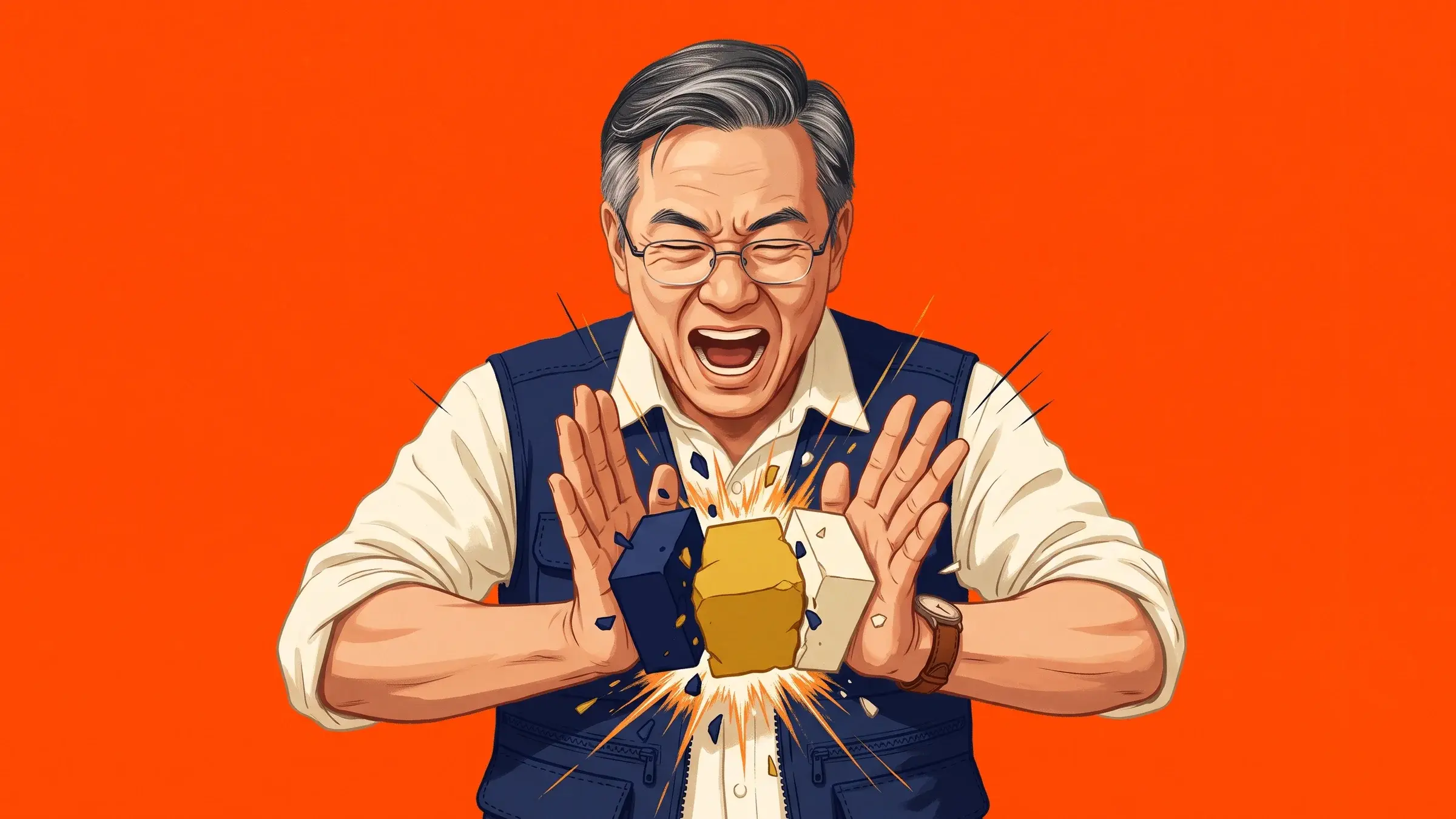
We wrote a locked style guide first: the illustration style, the palette, the rule that every cover is one character from a different part of the world acting out the post's idea, the camera angles, what's allowed in the frame and what isn't. For each post, a person decides the idea. For our last post on how AI is merging job roles, the idea was a man slamming two blocks together so they fuse into one. AI drew it. We judged it against the guide, fixed what didn't fit, and only then published it.
The same pattern runs through our client work. Our script-to-video pipeline produces finished branded videos at a pace no editor could match by hand, but the script, the brand rules and the final yes are human. Our brand-standout approach starts from what makes a brand different before any tool is opened.
AI does most of the hours. People do the parts that decide whether the work is any good.
What should you do this week?
- Write before you prompt. For your next piece of creative work, write a one-paragraph brief in your own words before you open any AI tool.
- Lock one standard. Pick one thing you make often (social graphics, proposals, product photos) and write down what good looks like. That's your style guide, and it's the most valuable prompt you'll ever write.
- Judge harder. When AI output looks finished, ask whether it's yours or just good. If it could have come from anyone, push back.
- Keep your stories. Your experience, your clients, your opinions. AI has read everything except what only you know.
The people who do well in the next few years won't be the ones who avoid AI, or the ones who hand everything to it. They'll be the experts who lead it. If you want an AI content setup built around your brand's own standard, not the average one, that's what we build.